The Season of Waiting: Palestinian Engagement Traditions
Where love is not only a bond between two hearts, but a covenant woven through family, patience, and generations of tradition.
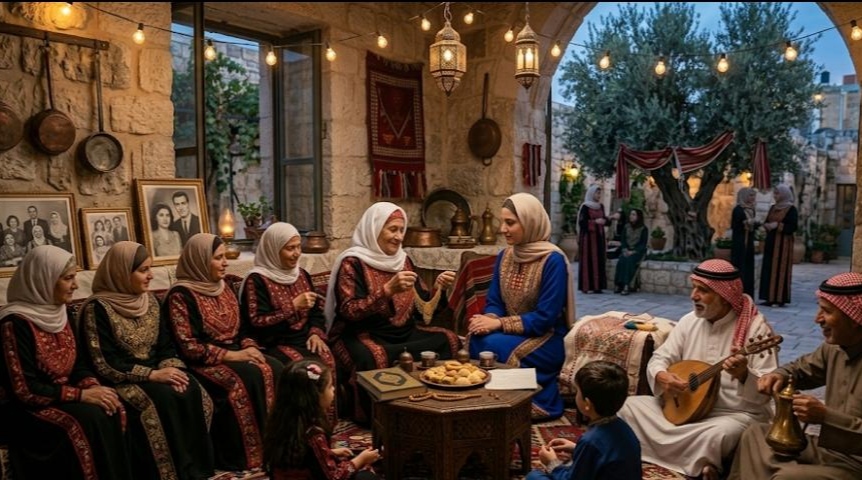
Engagement in Palestine
In Palestinian society, engagement is far more than an agreement between two individuals; it is the joining of two families and a deeply rooted social occasion shaped by traditions passed down through generations. These customs infuse life with warmth, dignity, and a sense of communal joy. Though details may vary from one city or village to another, the spirit and structure of Palestinian engagement traditions remain remarkably consistent.
The Traditions and Stages of Engagement in Palestine
The Jahah — Asking for the Bride’s Hand The journey begins with the Jahah, a formal visit in which the groom arrives accompanied by respected elders and prominent figures from his family or community to ask for the bride’s hand from her father. It is a gathering built on courtesy, honor, and mutual respect, during which matters such as the mahr — including both the immediate and deferred dowry — and the conditions of marriage are discussed and agreed upon.
The Recitation of Al-Fatiha Once both families reach an agreement, Surah Al-Fatiha is recited. This moment carries profound symbolic weight in Palestinian culture, as it marks the official public announcement of the engagement and seals the understanding between the two families.
The Recitation of Al-Fatiha
Once both families reach an agreement, Surah Al-Fatiha is recited. This moment carries profound symbolic weight in Palestinian culture, as it marks the official public announcement of the engagement and seals the understanding between the two families.
The Mashayeh or Nishan Gathering
In many families, a modest celebration follows, where the couple exchange the shabka — the bridal gold jewelry — along with gifts presented before close relatives and loved ones. Though simple in appearance, this gathering carries deep emotional significance, symbolizing the beginning of a shared future.
The Engagement Period — A Time of Patience and Preparation
The engagement period stretches between the formal engagement and the wedding itself. There is no fixed duration; it may last months or even years depending on circumstances, particularly if the groom is working to prepare a home for marriage. Beyond preparation, this period serves a deeper purpose: allowing the couple to grow closer while strengthening the bond between their families. In Palestinian culture, engagement is not viewed merely as waiting for a wedding day, but as the slow building of a life meant to endure.
Story: Ruqayya and Grandmother Layla — “Threads of Patience”
• A House Small in Size, Vast in Love The house was modest, yet somehow spacious enough to hold all the love in the world. Ruqayya, with her quiet smile and eyes the color of summer olives, sat beside her grandmother Layla. That evening, she entered the room wiping away a silent tear and said in a trembling voice: “Grandmother… my engagement feels endless. Ahmad has been abroad for months, working far away, and I don’t know when he’ll return so we can finally set the wedding date. I feel as though waiting is stealing the most beautiful years of my life.”
The Wisdom of Olive Trees
Grandmother Layla sighed softly and placed her weathered hand over Ruqayya’s. Her voice carried the warmth of an old radio humming through winter nights. “My daughter, love in our country is like an olive tree — it does not bear fruit without patience and care. Your grandfather, may God rest his soul, remained engaged to me for three years before we managed to build only two small rooms. Every letter he sent through the mail felt like Eid arriving at my doorstep.” Ruqayya looked at her curiously. “But how did you endure the waiting, Sitty?” Layla smiled gently.
Embroidering Hope into Every Stitch
“I embroidered my wedding dress with my own hands,” she said. “With every stitch, I imagined the day I would see him again. Engagement is not merely waiting; it is the season in which we plant our roots deeply into the earth before we grow together.” She paused, her eyes drifting somewhere far beyond the room. “Ruqayya, haste has no place in things built to last. And remember this well: every day you spend apart will only make the moment you finally hold each other beneath one roof more precious.”
The Night Patience Became Strength
That night, Ruqayya stood before her mirror and gently wiped away her sadness. She realized that her grandmother was not simply telling stories of the past — she was planting patience inside her heart. From that day forward, Ruqayya chose to embrace her engagement period differently. She dedicated herself to learning, growing, and preparing her future home with touches shaped by her own dreams. And as she waited for the day she would walk toward her wedding, she understood that she would arrive not only as a bride, but as a life companion who had learned the true meaning of patience, devotion, and enduring love.