The Music of the Flame: The Philosophy of the Mihmasah and Honoring the Soul
"Manual Coffee Roasting: When preparing coffee transforms into a ritual of patience and dignity; documenting the Palestinian's relationship with fire and the coffee beans crafted to be the first message of welcome to a guest."
Introduction: The Rhythm of Fire Before Speech
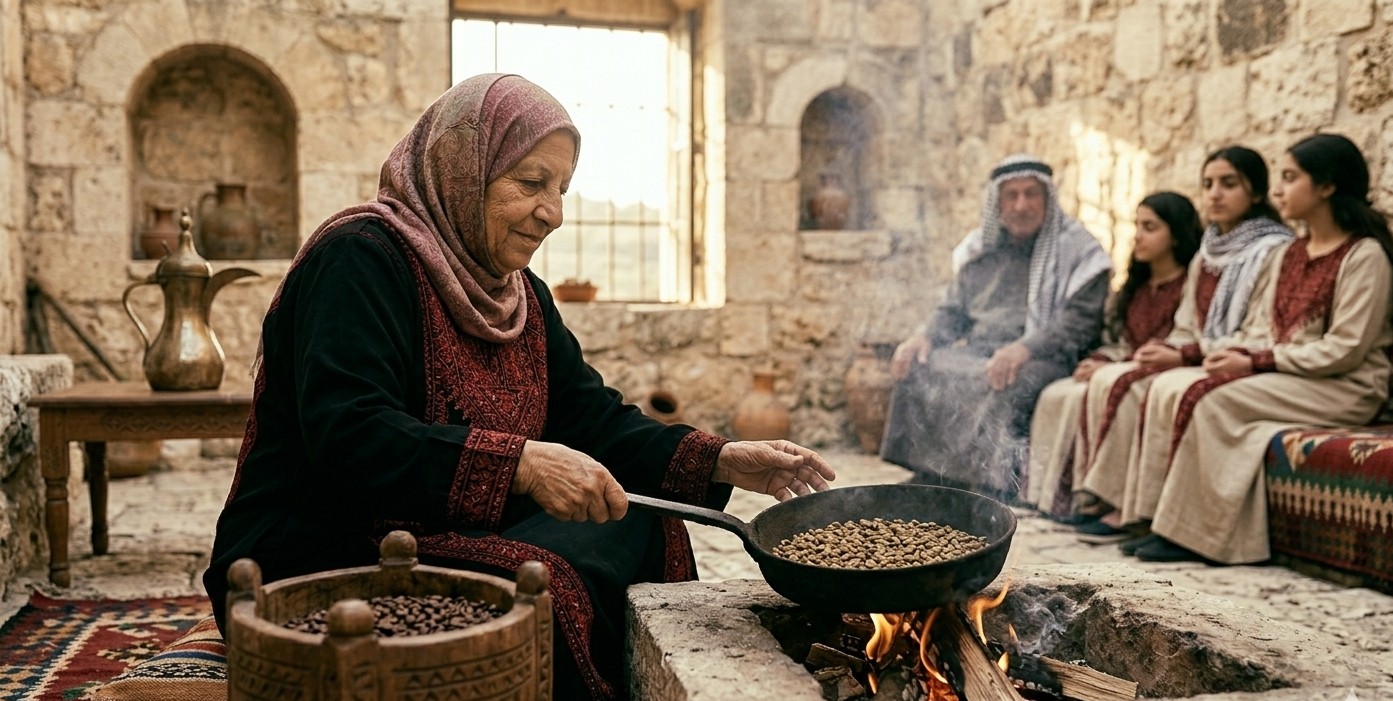
In the corner of the Maddafa (guest house) or by the edge of the Kanoun (brazier) on nights when the cold bites hard, a welcome does not begin with the words "Ya Hala" alone. It begins with a rhythmic metallic sound that cuts through the silence of anticipation. It is the Mihmasah (roasting spoon)—the tool that turns green coffee beans over wood embers, transforming them into dark gems radiating warmth. In Palestine, honoring a guest is not bought ready-made; it is crafted from scratch, with music that precedes the cup, telling the visitor that the host has dedicated both time and effort for their sake.
The Philosophy of Roasting: Patience is the Peer of Generosity
Roasting is not merely the act of turning beans; it is the "Scale of Patience." The fire must be "calm," much like the spirit of the host, and the stirring must be constant so the beans neither burn nor remain raw. The young girl, watching this process, realized that Palestinian coffee is a school of "composure"; for he who lacks the patience for the fire of the Mihmasah will lack the patience for the needs of the people. As the coffee bean shifts from green to gold and then to deep brown, it tells the story of transformation from "absence" to "presence." It is a silent message to the guest that their status is noble, deserving the toil of standing before the flames and following the details with ultimate precision.
The Role of Woman: The Balance of Flavor and Guardian of Chivalry
Behind every vibrant Diwan, the Palestinian woman stands as the "Trustee" of the quality of authenticity. It is she who selects the coffee beans with care, and she who perceives—through "scent" before "sight"—when the coffee has reached perfection. She is the "Architect of Awareness," teaching her children that honoring a guest begins with choosing the finest beans and ends with presenting the cup with a steady right hand. The woman here is the one who preserves the "secret of the blend": when to add the cardamom and how to cool the beans in the wooden Mubarrad (cooler) to retain the soul of the land. She has made coffee a sovereign ritual; no stranger enters her home without leaving with the memory of a hospitality crafted specifically for them, with a love untainted by the speed of machines or the falseness of the ready-made.
A Dialogue of Wisdom: Coffee is the "Salt of Men"
The grandmother said, following the movement of the Mihmasah with a calm smile: "My daughter, coffee in our land is not just a drink; it is a 'Book.' The Mihmasah heralds to the guest the arrival of joy, and its sound in the neighborhood used to tell people that this door is open to all. My dear, he who roasts his coffee by hand knows the value of his dignity, and the guest who drinks from coffee you toiled over feels like a king in your home."
Conclusion: The Covenant Written in Cardamom
The young girl realized that this manual ritual is what gives Palestinian hospitality its prestige. The music emanating from the collision of the Mihmasah with its metallic "hand" is a universal language of serenity and welcome. We are a people who feed the fire before we feed the guests, ensuring that every cup leaving our homes carries the taste of honest toil and the grandeur of belonging. The grandmother concluded her talk with a profound saying: "Coffee that is not made with patience cannot be served with prestige; so be the guardian of your fire, and you shall win the hearts of your guests."