The Sage Teapot: The Countryside’s Fragrance and the Guardian of Serenity
"The Sage Teapot: When the essence of the soil transforms into a daily dose of warmth—a profound documentation of the Palestinian relationship with the holy herb 'Miramiyyeh', which perfumes our homes and heals our hearts."
Introduction: The Call of the Earth inside the Cup
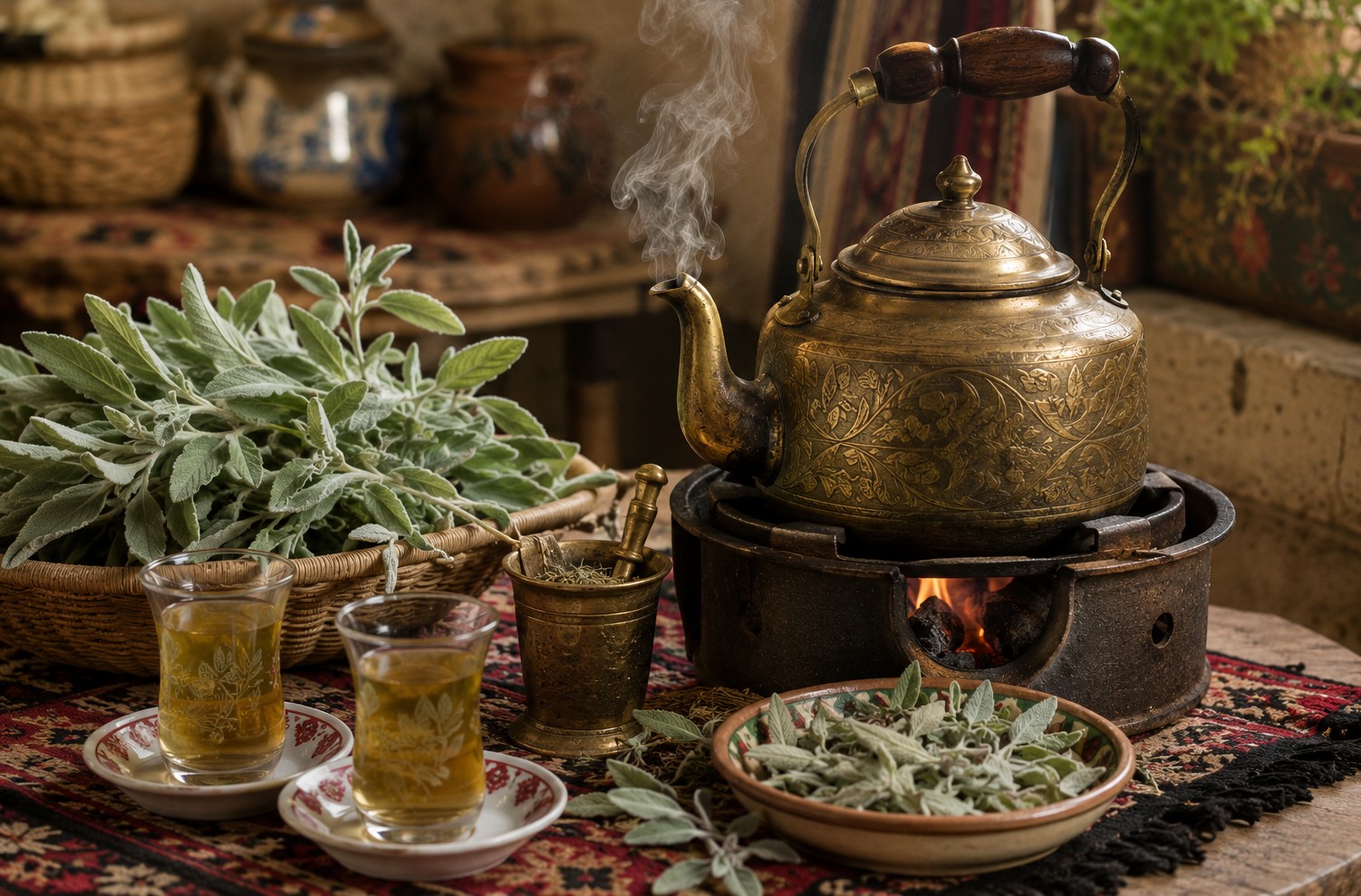
The moment the steam rises from a brass teapot over the Kanoun (traditional charcoal brazier) or a kitchen stove, an unmistakable aroma fills the air—one that no Palestinian could ever mistake. It is the scent of the mountains, of soil steeped in dignity. In our homeland, the sage teapot is the "permanent fragrance of the house," which precedes words of gentle blame and melts away mountains of worry. It is steeped with black tea to grant it the "majesty of the land," or brewed alone as a remedy and solace. Between the two lies a love story between a people and a herb that has never failed its keepers.
The Botanical Essence: Insights from the Soil(Miramiyyeh—or Maryamiyyeh, as it is pronounced in certain rural villages—is a perennial herbaceous plant belonging to the Lamiaceae family, known scientifically as Salvia officinalis. It forces its way through the cracks of Palestinian limestone hills in the spring, reaching its absolute prime in the summer when the mountains carry its aromatic breeze into every home.)
- Growth Environment: Arid, rocky, limestone mountain soils; it grows wild across the hills of Palestine.
- Harvest Season: Mid-summer, when the purple blossoms fully mature and the volatile essential oils reach their peak concentration.
- Drying Process: Meticulously dried in the shade to preserve its iconic silver-green hue and powerful, piercing aroma.
The Soul of Miramiyyeh: The Essence of Calamity and Poise
This noble herb tames the sharp sweetness of sugar and infuses the soul with a profound calmness that gently reorganizes our inner thoughts. It is the "companion of gatherings"; no winter night around the fire is complete without it, and no community council begins without its fragrance, which naturally commands presence, respect, and dignity.
From Mountain to Mountain: A Journey Through the Land's Anatomy(During his travels through Palestinian villages and cities, Adham discovered that the land possesses many faces, and so does its sage. Each region has its own dialect with this authentic herb, and its unique customs of serving it:)
- 1In the Mountains of Hebron (Al-Khalil): He observed how it thrives abundantly in the chalky hills. The locals are famous for adding heavy pinches of it to black tea during "Diwaniah" (community hall) gatherings, creating a dark, robust brew served with coarse sugar.
- 2In Jerusalem (Al-Quds) and Ramallah: He noticed a distinct preference for drinking the pure infusion entirely on its own, without tea. It is served light in small cups to early morning guests as a refreshing, fragrant greeting.
- 3In the Hills of Nablus and Jenin: He discovered the ancestral blends of grandmothers, where sage is mixed with wild thyme (Za'atar) and marjoram, offering a complex, rich flavor that packs the raw power of the mountain into a single sip.
The Master's Craft: How the Teapot is Prepared(Adham contemplated the preparation of this beverage for a long time, discovering that it is not merely about pouring hot water; it is an art form passed down through lineage, whose secret lies in preventing the "volatile oils" from escaping:)
- 1The Harvest and Drying: He found that grandmothers harvest the sage at the absolute height of summer, always drying it in the "shade" away from direct sunlight, ensuring the leaves retain their silver-green coat and lock the aroma tightly within.
- 2The Authentic Infusion: He learned from his household that sage "is steeped, never boiled" for long. The secret lies in placing the sprig—whether fresh green or dried—into the teapot immediately after it is taken off the fire, then sealing the lid tightly for several minutes. This gentle, quiet steeping is what coaxes out the essence of Baraka (blessing) and the smooth, sweet flavor.
The Mother’s Role: Guardian of the Green Pharmacy
The Palestinian mother is the one who transformed sage into an "icon" of the household. She is the one who plants it in earthenware pots to keep it within arm's reach, knowing exactly when to drop a single leaf and when to make the teapot heavy and robust depending on the family's needs. She is the "manager of health" who guided him to realize that nature is our first sanctuary, and that a single sprig of sage can outweigh a thousand synthetic medicines.
The Star of Wisdom (In the Words of Grandmother Laila)
Grandmother Laila gently lifts the steaming lid, letting the fragrant vapor cloud the air, then looks at young Adham, saying: "My son, Miramiyyeh is the very 'breath of the earth' in our home. A house where its scent wanders is a house that exile can never enter; for the aroma of our homeland expels all loneliness. Sage is like a pure, righteous soul—a little of it brings blessing to a lot, and its scent lingers deep within your spirit even after the cup is emptied."
Conclusion: The Fragrant Covenant of Belonging
Adham became certain that the sage teapot is the "aromatic covenant" binding him to the soil. We are a people who brew our sense of belonging in teapots, drinking our memories with every single sip, believing with absolute conviction that Miramiyyeh is an identity you drink, and a fragrance that can never be erased by the passage of time. May your teapots always remain full, and may the scent of sage forever bloom in your homes; for he who drinks the fragrance of his homeland will find the roots of loyalty blossoming in his heart.