Spinning Legends of Palestine
A journey into one of Palestine’s most beloved traditional games, where balance, rivalry, and heritage spun together
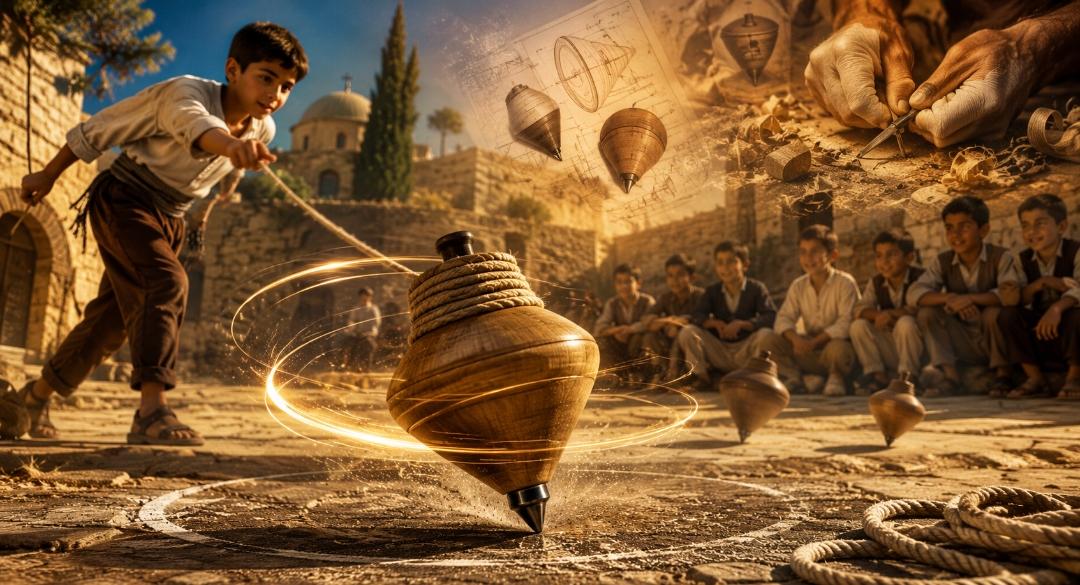
Wooden Whirls in the Courtyards of Heritage
• Circles of Joy The spinning top game, known in some Palestinian regions as Al-Dabbour, remains one of the liveliest traditional games preserved in Palestinian memory. Its sound once echoed through village alleys and city squares, filling them with the excitement of playful rivalry. The game depends on refined motor skill and precise control of balance and speed. In the same way that the handmade wire cart reflected a child’s talent for invention, the spinning top revealed mastery through movement and coordination.
The Meaning and Heritage of the Game
The spinning top is a cone-shaped wooden piece traditionally carved from sturdy olive or oak wood, ending in a pointed metal tip. More than a toy, it represents a cultural inheritance passed from one generation to another. It carries the spirit of challenge, patience, and fair competition that characterized many Palestinian traditional games.
Craftsmanship and Playing Technique
Although simple in appearance, the game requires careful craftsmanship and practiced skill. The top itself is carved with precision so it can maintain balance while spinning. A strong cotton string is tightly wrapped around it in a spiral motion, beginning at the metal tip and moving upward. At the center lies the pointed metal nail, the axis upon which the entire motion depends. Its sharpness and stability determine the quality of the spin.
The Art of Play
The game is far more than merely setting the top in motion. It is a practiced art. To launch it, the player throws the top forcefully toward the ground while pulling the string sharply, creating rapid rotational movement. In competitive play, each participant attempts to strike the opponent’s spinning top in order to stop its motion or knock it outside the playing circle drawn on the ground. The player whose top continues spinning the longest earns admiration and is often described as the cleverest among the group.
Social and Educational Importance
The spinning top taught children far more than amusement alone. It sharpened precision and concentration, helping them estimate distance, timing, and force. Matches were often held before groups of neighborhood children, strengthening social bonds and creating an atmosphere filled with laughter and collective excitement. Crafting the tops by hand also connected children to their environment, since selecting the proper local wood was an essential part of the process.
The Symbolism of Rotation in Palestinian Memory
The endless circular motion of the spinning top became a symbol of vitality and perseverance. Just as the wire cart came to symbolize movement and aspiration, and the mancala board symbolized wisdom and stewardship, the spinning top embodied balance and resilience in the face of challenge. It formed part of a natural educational world that helped shape the creative and enduring Palestinian character.