Traditional Games
Judge and Executioner
One of the simple folk games that combines entertainment with social learning.
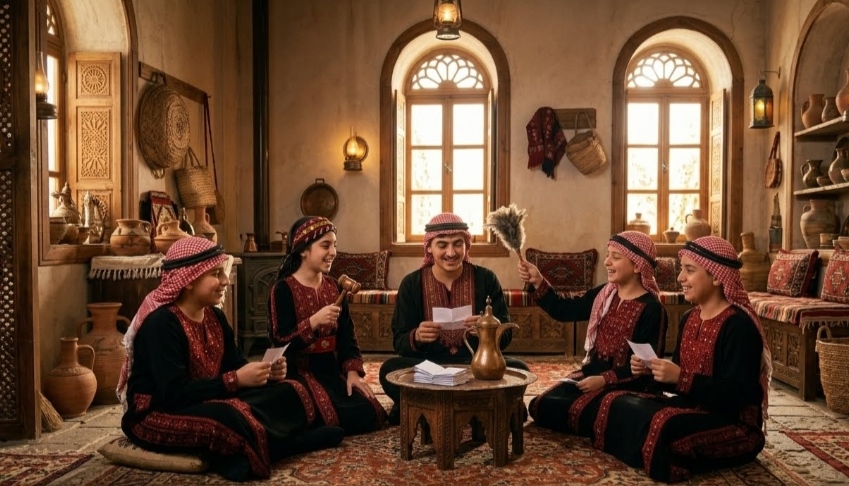
Overview
It is a traditional group game that children used to play in schools and open spaces. It depends on roles, acting, and cleverness in asking questions. It is played by both girls and boys, usually starting with four players, while others may take turns joining and exchanging roles with them. The players sit in a circle in the yard of the house, in the neighborhood, or even in an open area.
How to Play
- Small square slips of paper are prepared, with different words written on them to define the main roles. For example, there is a judge, an executioner, a police officer, and a thief, and each paper represents a specific character. The judge is the one who makes the decisions in the game, while the police officer tries to identify the thief and present them to the executioner. The executioner is the one who carries out the judge’s decision. Everyone closes their eyes, and the papers are distributed randomly. Each player picks a folded slip to discover the character assigned to them. The police officer then begins asking questions in order to identify the thief. If the police officer succeeds in finding out who the thief is, they inform the judge, and the punishment for the thief is decided and carried out by the executioner. Whatever the punishment may be, it is then carried out, and after the round ends, the roles are changed so that everyone can participate.
Skills Developed by the Game
- Thinking and analysis, especially when trying to discover the thief. Dialogue and communication skills. Acting and imagination through role-playing. Attention and observation to notice who is behaving differently. Cooperation and teamwork among the players. Building self-confidence when speaking or performing the punishment in front of others.
The Social Context of the Game
- 1Group interaction: the game depends on having a group of players, so it strengthens group spirit and social communication among them. Fun and entertainment: it is often played during free time or at family and school occasions for enjoyment and to break boredom. Simple competition: it includes a sense of challenge and curiosity in discovering the roles and results, which makes it attractive to children.