Mancala: Where Stones Became a Language of Wisdom
In Palestinian homes and harvest fields, this timeless game transformed simple pebbles into lessons of patience, strategy, and balance.
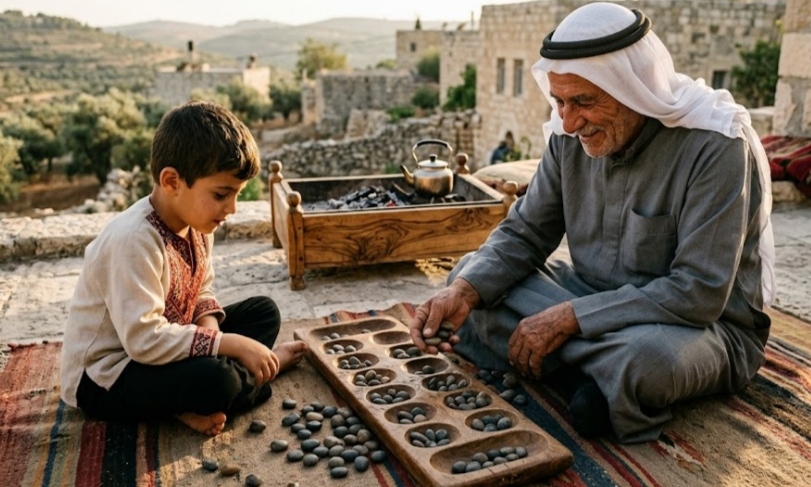
Mancala: Pebble Calculations and the Wisdom of the Ancestors
The Essence of the Game and Its Cultural Value Mancala was long known as “the game of the wise.” It stands as a living reflection of Palestinian intellectual heritage and the deep-rooted appreciation for thought, patience, and strategy within traditional society. In earlier times, people played Mancala during harvest seasons or throughout long winter evenings gathered around the kanoun, the traditional charcoal heater that brought families together in warmth and conversation. The game reveals how Palestinians transformed the simplest materials into remarkably sophisticated systems of counting and planning.
A Playing Field Inspired by Nature
The beauty of Mancala lies in its simplicity and closeness to the land. Everything about the game is crafted from ordinary elements found in daily life. The Board The Mancala board is traditionally carved from wood, though some versions were shaped directly into stone or hard ground. It consists of two parallel rows, each containing seven small pits. The Pebbles The game is usually played with ninety-eight small pebbles or seeds distributed evenly across the board. At the beginning of the game, each pit contains seven stones.
The Rules of Play: The Art of Distribution and Capture
Mancala is built upon calculation, anticipation, and tactical thinking. The Objective The aim is to collect the largest possible number of pebbles in the player’s “home” pit or to capture the opponent’s stones through clever movement. The Distribution Method A player begins by picking up all the stones from one pit on their side and distributing them one by one into the following pits in a counterclockwise direction. Every move requires careful planning, since the placement of the final pebble can completely change the course of the game. Capturing Stones If the final pebble lands in one of the opponent’s pits and creates an even number of stones — such as two, four, or six — the player captures all the stones in that pit and adds them to their score. This rule turns the game into a subtle contest of prediction and mental precision.
Social and Educational Importance
Mancala was never viewed as mere entertainment. It served as a natural school for sharpening the mind and strengthening social bonds. • Developing Mathematical Skills The game helped both children and adults improve mental arithmetic, quick counting, addition, and strategic calculation. • Patience and Self-Control Success in Mancala demands composure, long-term thinking, and the ability to anticipate several moves ahead. • Respectful Competition Games were often played in an atmosphere of dignity and mutual respect, surrounded by spectators who admired the intelligence and skill of the players.
A Symbol Within Palestinian Collective Memory
Mancala carries meanings far beyond the board itself. In Palestinian popular memory, the pebbles symbolize seeds, sustenance, and blessings. Their movement from one pit to another mirrors the rhythms of agricultural life — sowing, harvesting, storing, and distributing resources wisely. For this reason, Mancala became a quiet metaphor for fairness, household management, and the wisdom required to preserve prosperity across generations.
The Memory Hidden Between the Stones
Even today, an old Mancala board resting in a Palestinian courtyard tells a story larger than the game itself. It speaks of winter gatherings, thoughtful hands moving pebbles one by one, and a heritage where intelligence flourished through simplicity, patience, and human connection.