Seven Tiles: The Game That Built a Community
A Palestinian street game where teamwork, courage, and childhood strategy turned narrow alleys into arenas of memory and belonging.
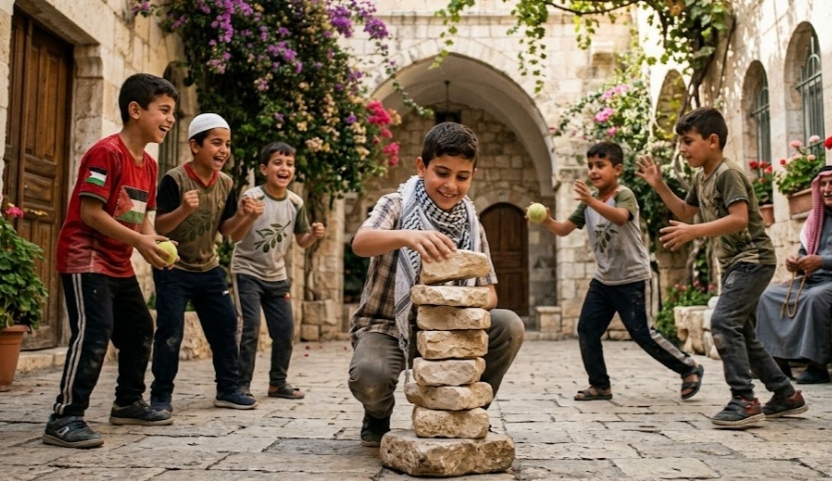
Seven Tiles: The Strategy of the Neighborhood and the Spirit of Palestinian Community
1. The Heart of the Game Seven Tiles is one of the most beloved traditional games once played throughout Palestinian villages, refugee camps, and old city alleyways. At its core, the game depends on teamwork. It combines precision, quick thinking, agility, and collective coordination, making it an instinctive lesson in solidarity among the children of the same neighborhood. For many Palestinians, it was never merely a game — it was a ritual of belonging.
2. Tools Borrowed from the Land
The beauty of Palestinian folk culture appears in the simplicity of the game’s materials, all drawn from the surrounding environment. • The Tiles The “seven tiles” are usually made from seven flat stones, broken pottery pieces, or fragments of old floor tiles. Children carefully select them so they can be stacked steadily into a small tower. • The Ball In earlier generations, children handcrafted the ball using scraps of cloth and worn-out socks stuffed with cotton or sand to give it weight. Today, tennis balls or rubber balls are commonly used instead.
3. The Playing Field: Two Teams, One Mission
The players divide themselves into two equal teams: • The Attack Team (The Builders) Their mission is to knock down the stack and rebuild it again. • The Defense Team (“The Hunters”) Their role is to stop the builders by striking them with the ball before the tower is rebuilt.
4. The Ritual of Beginning: Bringing Down the Tower
The seven tiles are stacked one on top of another at the center of the playing area. A member of the attacking team stands at a marked throwing line and hurls the ball toward the tower. The moment even a single tile falls, the real excitement begins. The attacking players scatter through the alleyways and open spaces, while the defending team rushes to retrieve the ball.
5. The Chase and the Rebuilding Battle
This is where the game becomes truly thrilling. The attacking team must find opportunities to run back toward the center and rebuild the seven-tile tower piece by piece. At the same time, the defenders pass the ball rapidly between teammates, trying to hit the attackers before they complete the structure. Any player struck by the ball is eliminated from the round. The game transforms into a fast-paced contest of movement, sacrifice, distraction, and strategy.
6. The Cry of Victory
If the attackers succeed in rebuilding the seven stacked tiles before all their players are eliminated, they erupt in celebration, shouting together: “Seven Tiles!” or simply, “Done!” Their voices echo through the neighborhood amid laughter, excitement, and the joyful ululations of childhood.
7. The Social and Educational Values of the Game
Seven Tiles carried lessons far greater than play itself. • Sacrifice and teamwork Often, one child would deliberately draw the defenders’ attention away from the tower, allowing another teammate the chance to rebuild it safely. • Precision and focus The game sharpened aim, coordination, and spatial awareness. • Connection to place Doorsteps, village squares, and the narrow alleys of refugee camps became living playgrounds filled with movement and joy. In this way, the game turned ordinary streets into spaces of cultural memory and collective identity.
8. A Symbol Deeply Rooted in Palestinian Memory
In Palestinian collective memory, “Seven Tiles” became more than a childhood game. It evolved into a quiet metaphor for rebuilding. No matter how many times the tower collapses, the players keep returning to stack the stones again — one piece upon another. And in many ways, that image mirrors the Palestinian story itself: persistence, reconstruction, and the refusal to surrender, even after repeated loss.