Seega: Battles Drawn in Sand and Stone
A timeless Palestinian strategy game where patience, intelligence, and silent calculation shaped the gatherings of village life.
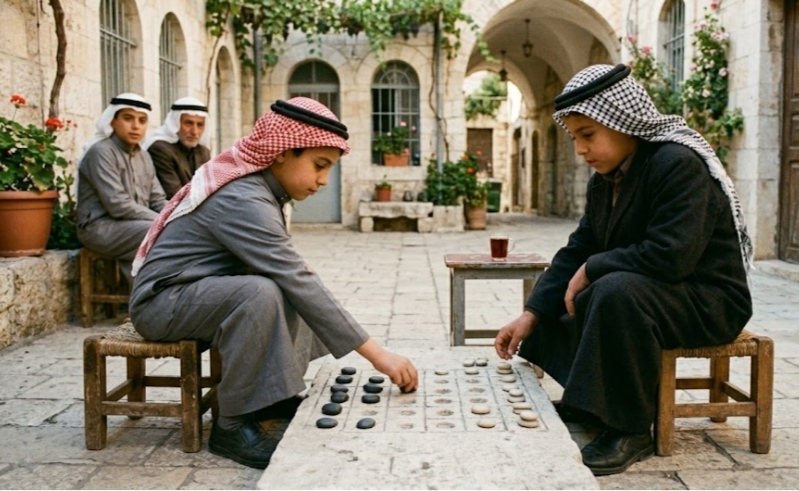
Seega: The Strategic Duel of Minds on Palestinian Soil
1. The Essence of the Game and Its Cultural Place Seega is regarded as one of the oldest strategic board games in Palestinian heritage. For generations, it accompanied farmers during harvest seasons on the bayader — the traditional threshing grounds — and filled the evening gatherings of elders in village diwans, the communal guesthouses where stories, wisdom, and debates were shared. More than entertainment, Seega reflected qualities deeply admired in Palestinian culture: foresight, patience, restraint, and the ability to outmaneuver an opponent through intelligence rather than force.
2. The Playing Field: Inspired by the Land Itself
One of the most beautiful aspects of Seega lies in its simplicity. The game does not require an elaborate wooden board or expensive pieces. Everything comes directly from the surrounding environment. • The Board Players create the board by digging twenty-five small holes or squares into sand or hard ground. These spaces are traditionally known as al-kalb or al-bayt — the house or the place. • The Stones Instead of crafted game pieces, players use small pebbles or colored stones gathered from the land itself. Each player owns twelve stones distinguished by color — often white against black.
3. The Philosophy and Rules of Seega
Seega is built upon tactical positioning, anticipation, and calculated movement. • The Placement Phase The players begin by placing their stones alternately into the spaces on the board. The central square remains empty at the start of the game, creating the opening point for movement and strategy. • The Art of Capture Victory depends on trapping the opponent’s stones. If a player succeeds in positioning an opponent’s piece between two of their own stones — either horizontally or vertically — the trapped stone is “captured” and removed from the board. • Strategic Movement Players may move their stones in every available direction except diagonally, constantly searching for weaknesses in the opponent’s formation. The game becomes a quiet duel of prediction and patience, where every move can alter the balance of the board.
4. The Etiquette of Play: The Silence of the Diwan
Seega carries a distinctive dignity within Palestinian social tradition. It is often played in deep concentration and near silence, as players carefully anticipate the next move. Around them gathers a circle of spectators — elders, friends, and neighbors — who observe attentively. According to the unwritten etiquette of the game, no spectator is allowed to interfere or offer advice. This tradition reinforces values highly respected in Palestinian society: self-reliance, composure under pressure, and strength of character.
More Than a Game
Seega was never merely about winning or losing. It represented a cultural space where intelligence was admired, patience was tested, and human connection unfolded quietly over sand, stones, and shared time. Even today, the image of two players bent over a handmade board in the middle of a Palestinian courtyard remains one of the most authentic symbols of traditional social life — simple in appearance, yet rich in meaning and memory.