The Wire Cart: When Palestinian Childhood Learned to Invent
Crafted from discarded materials and boundless imagination, this handmade toy became a symbol of resilience, creativity, and joyful survival.
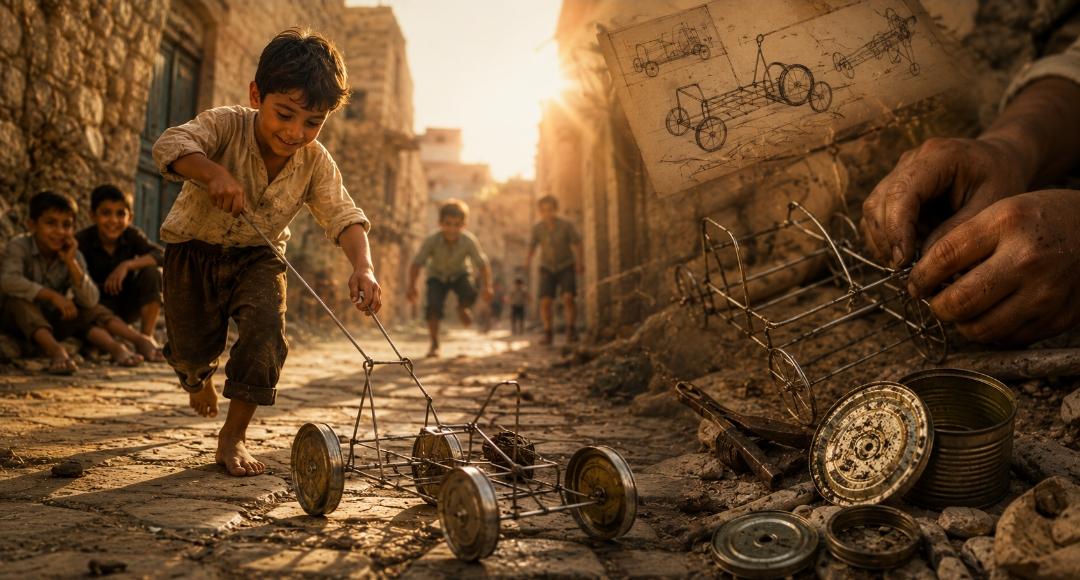
The Wire Cart: Childhood Engineering and the Art of Creating from Necessity
The Wire Cart, known in some Palestinian communities as the Wire Car, stands as one of the clearest symbols of popular creativity in Palestinian childhood. It was never simply a toy. It was a living expression of a child’s ability to transform the modest resources surrounding them into a world filled with excitement, movement, and friendly competition.
The Idea and the Spirit of Innovation
In a time before plastic toys and electronic games became widely accessible, Palestinian children relied on manual skill, imagination, and ingenuity. The Wire Cart was a handmade vehicle crafted from recycled metal wire and improvised materials gathered from everyday life. It reflected the values deeply rooted in Palestinian society: self-reliance, resourcefulness, and the ability to create beauty and joy from limited means. Just as traditional games like Mancala reflected intellectual sharpness and mathematical thinking among adults, the Wire Cart revealed the practical intelligence and inventive spirit of children.
Materials and the Mechanics of Creation
The beauty of the Wire Cart lay in its simplicity and its imitation of real vehicles seen in daily life. • The Frame Children used strong metal wire — often leftover construction material — to build the skeleton of the cart as well as its long steering handle. The wire had to be bent carefully by hand to achieve balance and movement. • The Wheels The wheels were usually fashioned from empty metal food cans, jar lids, or pieces of old rubber. Every discarded object held the possibility of becoming part of a moving creation. • The Steering Handle A long metal rod ending in a circular grip allowed the child to guide the cart while running behind it through the narrow alleys of villages and refugee camps. The faster the child ran, the louder the wheels rattled against the stone roads — a sound deeply etched into Palestinian memory.
Social and Educational Dimensions
The Wire Cart was far more than a pastime. It quietly taught children essential life skills. • Developing Manual Skills Building the cart introduced children to the basics of balance, structure, assembly, and simple engineering. Every cart carried the personal signature of its maker. • Honest Competition Children often organized races through neighborhood streets and open spaces. These competitions encouraged teamwork, confidence, and the spirit of fair play — much like the lively exchanges found in traditional Palestinian riddle gatherings. • A Reflection of Reality Many children designed their carts to resemble trucks, buses, or service vehicles they observed around them daily. This strengthened their powers of observation and connected play directly to the surrounding world.
A Symbol in Palestinian Collective Memory
In Palestinian memory, the Wire Cart represents the child who learned to create happiness out of almost nothing. It became a symbol of resilience and innovation under difficult circumstances. If the stones of Mancala symbolized sustenance and wisdom, and riddles symbolized sharp thinking, then the Wire Cart symbolized movement, determination, and the dream of pushing forward despite hardship.
A Heritage Written in Motion
The child who learned to bend stubborn wire into a moving toy was the same child who learned arithmetic through pebbles in Mancala and discovered life’s hidden meanings through traditional riddles. Together, these simple games shaped generations marked by creativity, endurance, and a profound attachment to Palestinian heritage.