Blown Glass: The Magic of Fire and Color in Hebron’s Alleys
"A journey into the philosophy of the 'Warm Breath'; where Hebron’s artisans transform silent sand into masterpieces of light and color, blending the heat of the furnace with the soul of the craftsman."
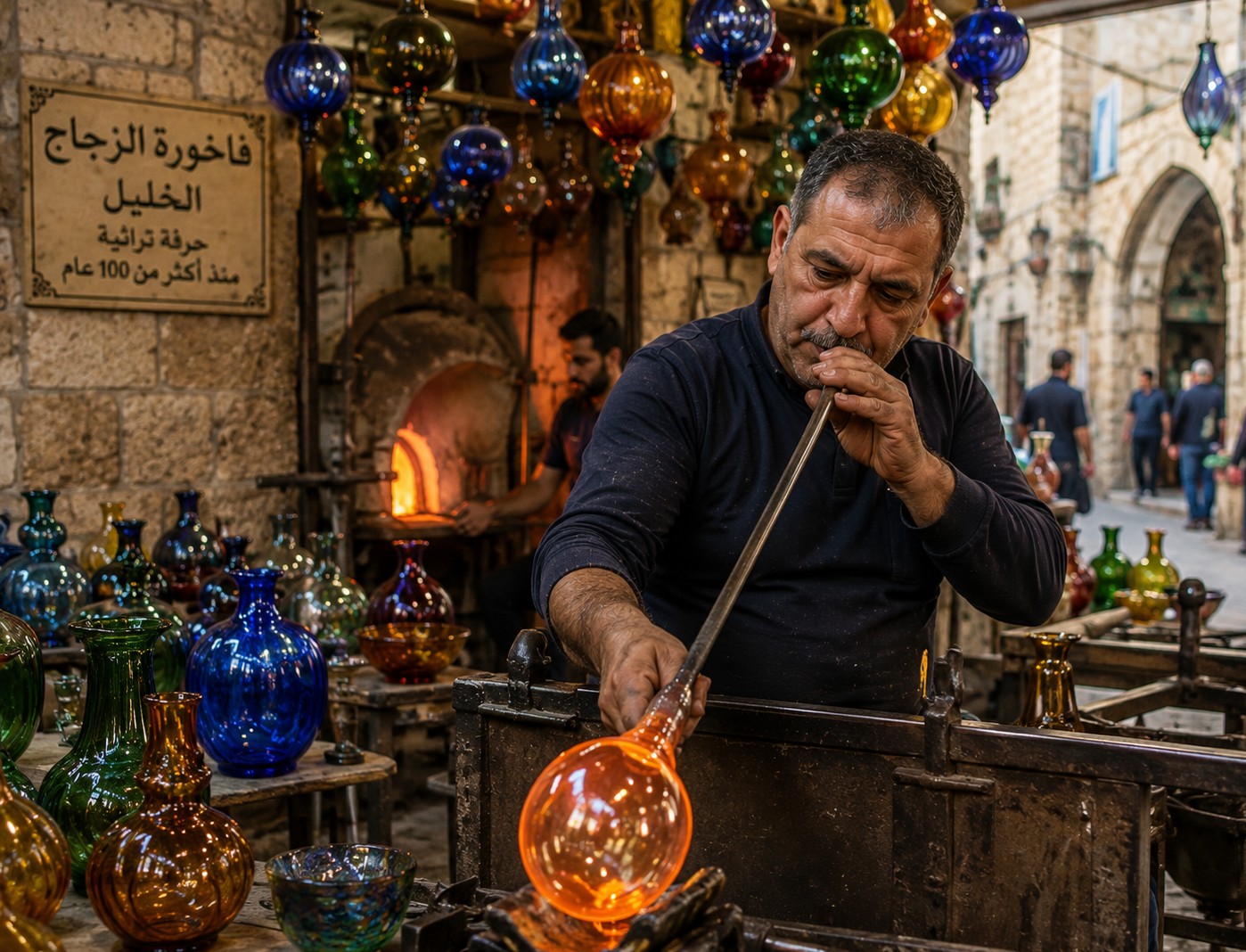
The Philosophy of the Warm Breath
The story begins with the philosophy of the "Warm Breath"; glass in Hebron is not just a transparent material, but a visual attempt to trap light within a solid form. It is the craft that transforms silent sand into a bold language of color, where the artisan’s breath mingles with the furnace's heat to create a being made of light. Blown glass is that ingenious balance between the spontaneity of handmade craft and a delicacy of form that is ahead of its time—much like the Kufiya, with its threads mimicking fishermen's nets and hawks' eyes, announcing a presence that never fades.
Where Beauty is Born from the Heat
In the ancient "Glass Fakhoura" of Hebron, you don’t need a clock to know when the day begins. Time here is measured by the moment the molten "dough" matures inside the furnace that never sleeps. Between the hiss of the fire and the clinking of the iron rod, beauty is born from the womb of intense heat. The artisan stands like a maestro, blowing into his long tube to give the molten clay soul, shape, and substance.
I. The Chemistry of Light: The Secret of "Hebronite" Color
What distinguishes Hebron glass is that blue stolen by the artisan from the sea of Jaffa, and the green borrowed from the olive groves. The secret lies in the natural "oxides" added to the melt, giving it a brilliance unlike any machine-made glass. The artisan here never repeats a piece; he allows himself the freedom to improvise with every "breath." Thus, the vessels and vases emerge like frozen musical compositions, carrying within them small air bubbles and spontaneous curves that bear witness to a human hand untouched by machines.
II. From the Breath of History to Modern Spaces
Blown glass was historically linked to the lanterns that illuminated the ancient houses of Jerusalem and the "Mkhal" (kohl containers) that adorned grandmothers' eyes. Today, we see this art boldly invading modern spaces; Hebronite glass chandeliers hang in the finest hotels and homes, and colorful "Phoenix" cups grace tables seeking distinction. It is the craft that transformed neglected "sand" into a precious "gem," proving that Palestinians possess the ability to tame the harshest conditions to produce beauty that delights the beholder.
The Star of Wisdom (In the Words of Grandmother Laila)
Grandmother Laila holds a piece of blue glass, raising it toward the sun to watch the reflection of light, and says to young Hazem: "My dear Hazem, look at this piece... its origin is fine sand, but when it entered the fire and found a hand that knew its worth, it became a masterpiece desired by all. My son, a human is like this glass; fire and hardships are what polish us and bring out our true colors. Do not fear the heat of the days; what matters is that your 'breath' remains kind and sincere. Cherish this glass, my dear, for it is transparent like our hearts, yet solid and strong like our presence on our land." And when you are far from Hebron—place a piece on your shelf, and when the light pierces through it, you will know that Palestine does not need a travel ticket to reach you.
Conclusion
Owning a piece of Hebron’s blown glass is a celebration of a light that never goes out, and a bow of appreciation to the artisans' breaths that faced the furnace's flames to keep our art burning bright. While the world settles for cold glass cast in rigid molds, our glass remains the "soul" that breathes color and light—the honest witness that our creativity is not melted by fire. Blown glass is still enduring.