Jerusalem Ceramic (Qashani): The Sky’s Brilliance on the Walls of the Soul
"A journey into the philosophy of 'Immortalizing Color'; where Jerusalem's clay is baptized by fire to become mirrors of the sky, preserving the city’s majesty in every tile."
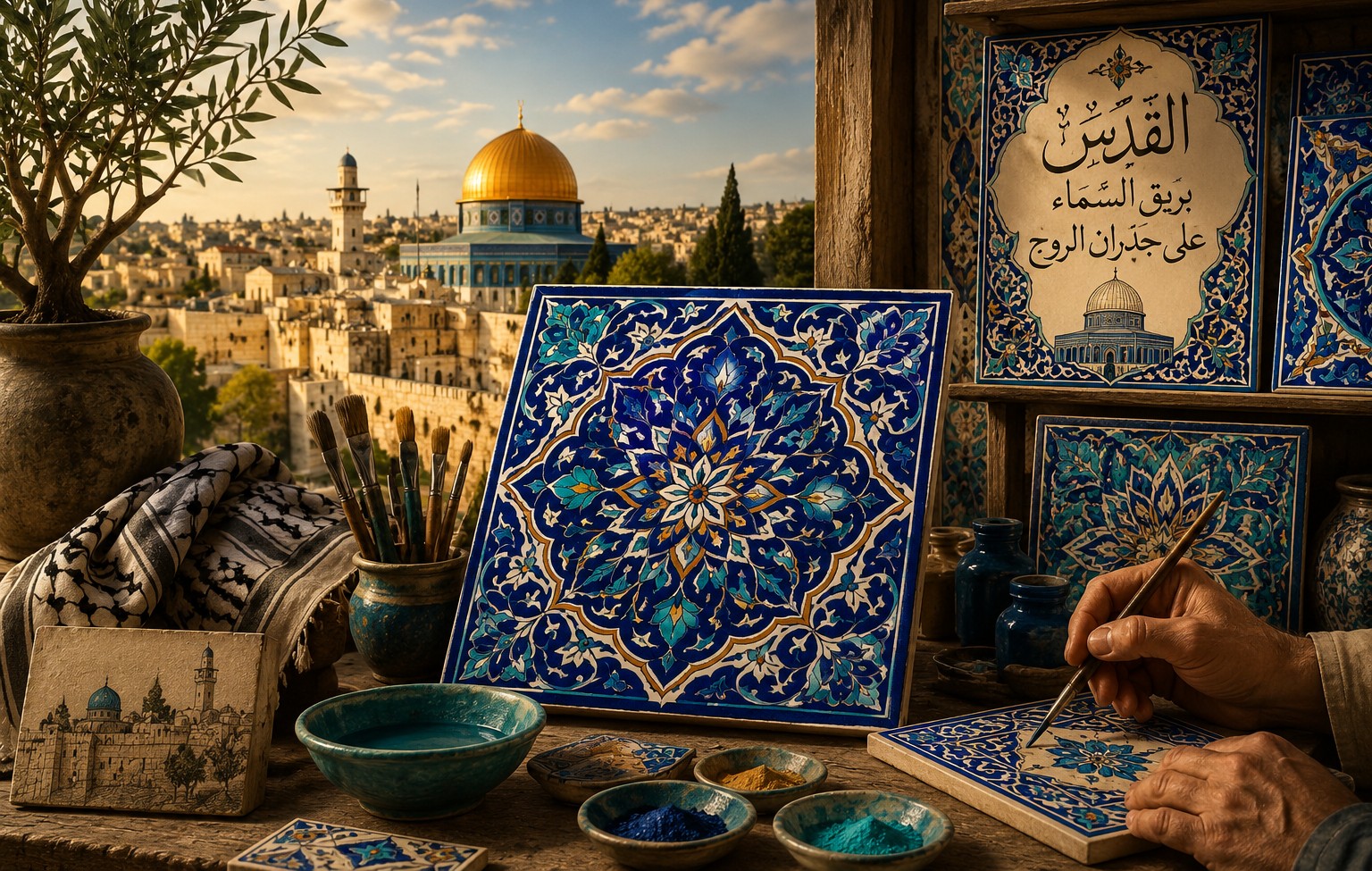
The Philosophy of Immortalizing Color
The story begins with the philosophy of "Immortalizing Color"; Qashani in Jerusalem is not just decorative tiling, but a visual attempt to translate the city’s majesty into a language of clay and fire. It is the craft that transformed Jerusalem’s walls and sanctuaries into celestial paintings untouched by the hands of time. Jerusalem Qashani is the enchanting balance between the geometry of thought and the depth of the soul—much like the Kufiya, with its patterns guarding the identity, announcing that beauty in our land is another face of resilience.
Inside the "Mashaghel" of Jerusalem
In the workshops of Jerusalem, where the air is thick with the scent of oxides and damp earth, success is not measured by the shine of a piece, but by its "Antique Soul." Here, time passes between the painter’s brush, tracing "lotus flowers" or "geometric motifs" with absolute precision, and the heat of the kilns that transform dull clay into gems, carrying a secret known only to those who draw their inspiration from the sanctity of the place.
I. The Blend of Clay and Fire: The Secrets of "Glazing"(What distinguishes Jerusalem Qashani is its handmade nature that rejects mechanical repetition. Each piece undergoes precise stages requiring the patience of Job:)
- Kneading the Soul: Special clay is used, kneaded, and shaped by hand, then left to dry completely before entering the kiln at high temperatures to solidify.
- Hand Painting: Then comes the stage of "outlining" with a fine brush. Decorative units inspired by Jerusalem’s architectural heritage are drawn using colors extracted from natural oxides.
- The Magic of "Al-La’ab" (Glazing): The piece is submerged in a layer of liquid transparent glass (glaze), then returned to the kiln for a second time. Here, the miracle occurs: the colors merge with the glass to emerge with a brilliance that grants the piece visual depth and an unparalleled resistance to the elements of time.
II. From the Walls of "Al-Aqsa" to the Corners of the Home
Historically, Qashani was linked to the restoration of the facades of the Dome of the Rock and the homes of Jerusalem’s notables, where it remains a symbol of prestige and refined taste. Today, Qashani is no longer confined to historical landmarks; it has become part of modern architectural aesthetics. We see it gracing entrances, transformed into wall murals, or even small decorative pieces that mimic the city’s grandeur. It is the craft that has managed to remain "brilliant" despite hardships, proving that he who possesses the secret of fire and color possesses a memory that never fades.
The Star of Wisdom (In the Words of Grandmother Laila)
Grandmother Laila touches a blue Qashani tile decorating her home’s entrance, wiping the dust off with love, then looks at young Hazem, saying: "My dear Hazem, do you see this blue? This isn't just a color; this is the sky of Jerusalem that the artisan brought down and placed on the wall. Qashani, my son, is like faith; no matter how much sun and wind pass over it, it keeps shining and its color never fades. My child, a house with Qashani walls stays cool at heart and long in spirit. Cherish this art, my dear, and know that he who preserves the 'brilliance' of his homeland will keep his face radiant even in the darkness of exile. Be like this Qashani: authentic, solid, and always shining." And when you are far from the alleys of the Old City and the fragrance of "Khan al-Zeit"—place a small Qashani plaque in your home. When your eyes fall upon it, you will feel the spirit of Jerusalem breathing with you, and that distance is but an illusion before the brilliance of the sky.
Conclusion
Owning Jerusalem Qashani is a celebration of a craft "baptized by fire" to remain eternal, and a tribute to the fingers that turned clay into mirrors for the soul. While the world settles for silent walls, Qashani remains the "pulse" that clothes our homes in majesty—the colorful message telling us that our beauty is rooted in the earth and rising toward the sky. Qashani is still enduring.