Embroidery (Tatreez): The Geometry of Triangles and Palestinian Memory
"A journey into the philosophy of 'Writing with the Needle'; where silk threads transform into visual maps, and every stitch tells the story of a village, a harvest, and a beautiful form of resistance."
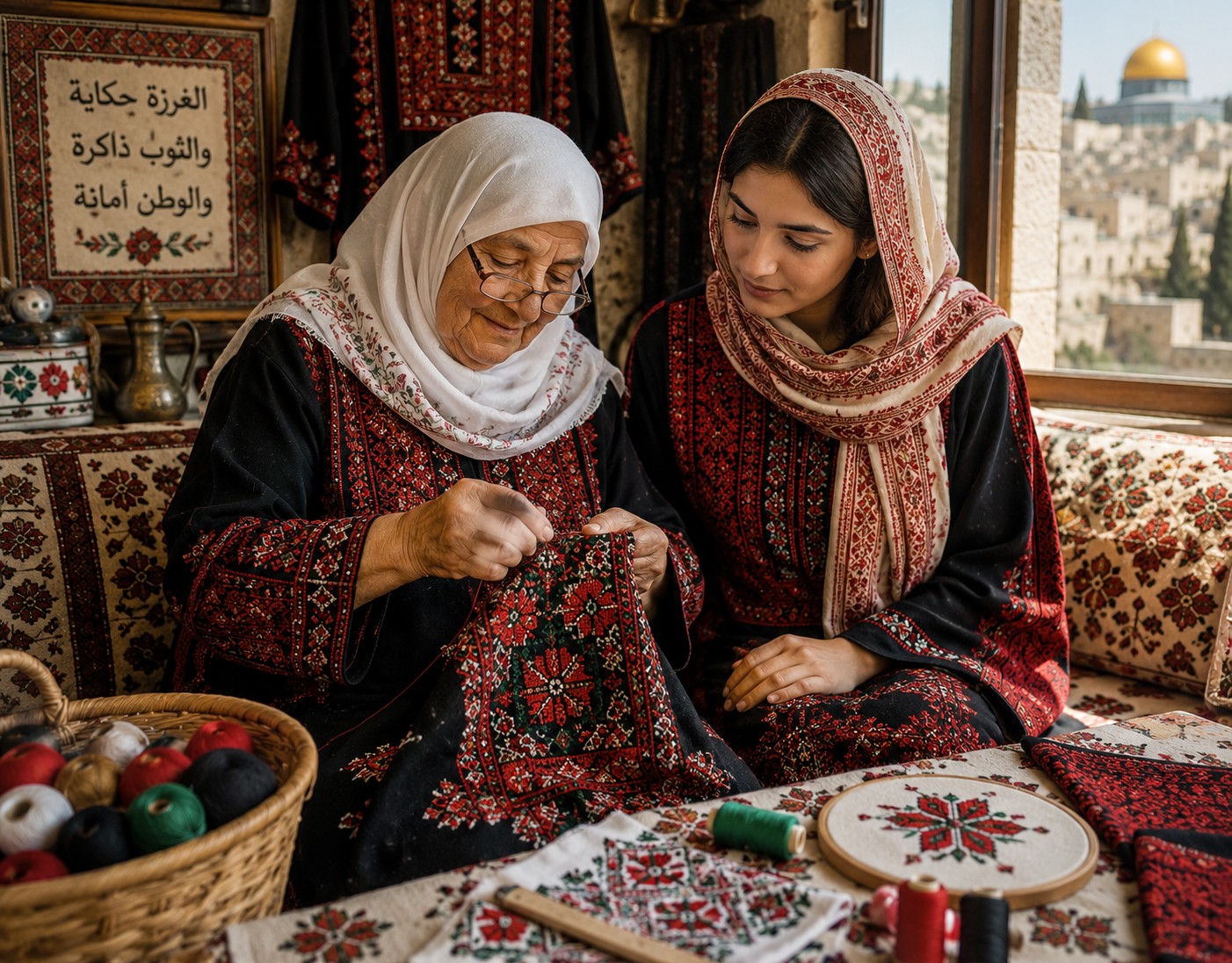
The Philosophy of Needle Documentation
The story begins with the philosophy of "Writing with the Needle"; embroidery in Palestine is not merely decorating fabric, but a moral "passport" carried by Palestinians wherever they go. It is the craft that transforms silk threads into visual maps, where every stitch tells the story of a village, a harvest season, and a form of resistance through beauty. Embroidery is the stunning balance between the rigors of geometry and the spontaneity of the soul—much like the Kufiya, which asserts its majesty in major forums, announcing that identity is never forgotten as long as there are hands that know how to weave it.
The Scene: The Council of Grandmothers and the History of the Thobe
In the grandmothers' "Diwan" (gathering hall), a woman's skill is not measured by the speed of her hands, but by her ability to "read" the Thobe. Here, time stops at the borders of the "Erq" (vein), the "Qilada" (necklace), and the "Manajil" (sickles). Every Thobe is a historical volume; from the deep burgundy of Ramallah to the "Lion of Gaza," the sparkle of Beersheba, and the ancient roots of Jerusalem and Hebron. Memory passes from one generation to the next, proving that the thread is the umbilical cord that binds us to our roots, no matter how long the absence.
I. The Language of the "Musallab": The Riddle of Triangles and Colors
What distinguishes Palestinian embroidery is its reliance on the "Musallab" (Cross-stitch), which builds precise geometric shapes that mimic nature. The "Triangle" is not just a passing shape; it is the "Sarwa" (Cypress tree) symbolizing unbowed steadfastness. The "Raqma" is not just a color, but an expression of village identity and the earth's seasons. Palestinian artisans do not draw randomly; they follow a complex geometric system combining symmetry and extreme precision. Here lies the secret: behind every decorative unit hides an ancient symbol, transforming the Thobe from a piece of cloth into a "fortress" protecting the story from extinction.
II. From Mothers' Dresses to a Global Language
Embroidery is no longer a prisoner of the old "closet"; it has broken free to adorn the details of our contemporary lives. Today, we see it gracing formal handbags, phone covers, neckties, and even modern furniture. It is the craft that managed to cross the "tunnel of time" without losing its luster, confirming that the "Stitch" is the language the whole world understands when we speak of belonging—a language that needs no translation, but a heart that perceives beauty and speaks it before the world.
The Star of Wisdom (In the Words of Grandmother Laila)
Grandmother Laila adjusts her glasses, running her hand over her "Malak" Thobe, then turns to young Ruqayya, saying: "My dear Ruqayya, do you see these threads? These are not just silk; these are our veins. When we embroidered, we were writing the names of our villages and forests with thread. My daughter, the Thobe you see 'stitched' with patience is what protects its owner's back from the treachery of time. Cherish this stitch, my dear, and know that the hand that holds the needle knows how to hold the land. Be like this embroidery: authentic, organized, and never out of style." And when you are far from the hills of Jerusalem and the orchards of Jaffa—carry a piece of embroidery with you. When you touch its stitches, you will know that Palestine is not behind you; it is with you in the details of your day, telling the world who you are.
Conclusion
Every silk thread that passes through your garment is a "message of resilience" crossing continents, and a tribute to those patient fingers that never let go of the "Musallab" even in the most difficult circumstances. While markets are filled with pale, soulless industries, Palestinian embroidery remains the "refined text" in which we read our steadfastness—the witness proving that our authenticity is too strong to be folded by forgetfulness. Tatreez is still enduring.