Olive Wood: The Earth’s Fragrance in Bethlehem’s Masterpiece
"A journey from the ancient groves to the artisan’s workshop, where olive wood is transformed from raw branches into timeless icons of resilience and elegance."
The Tale of Eternal Roots
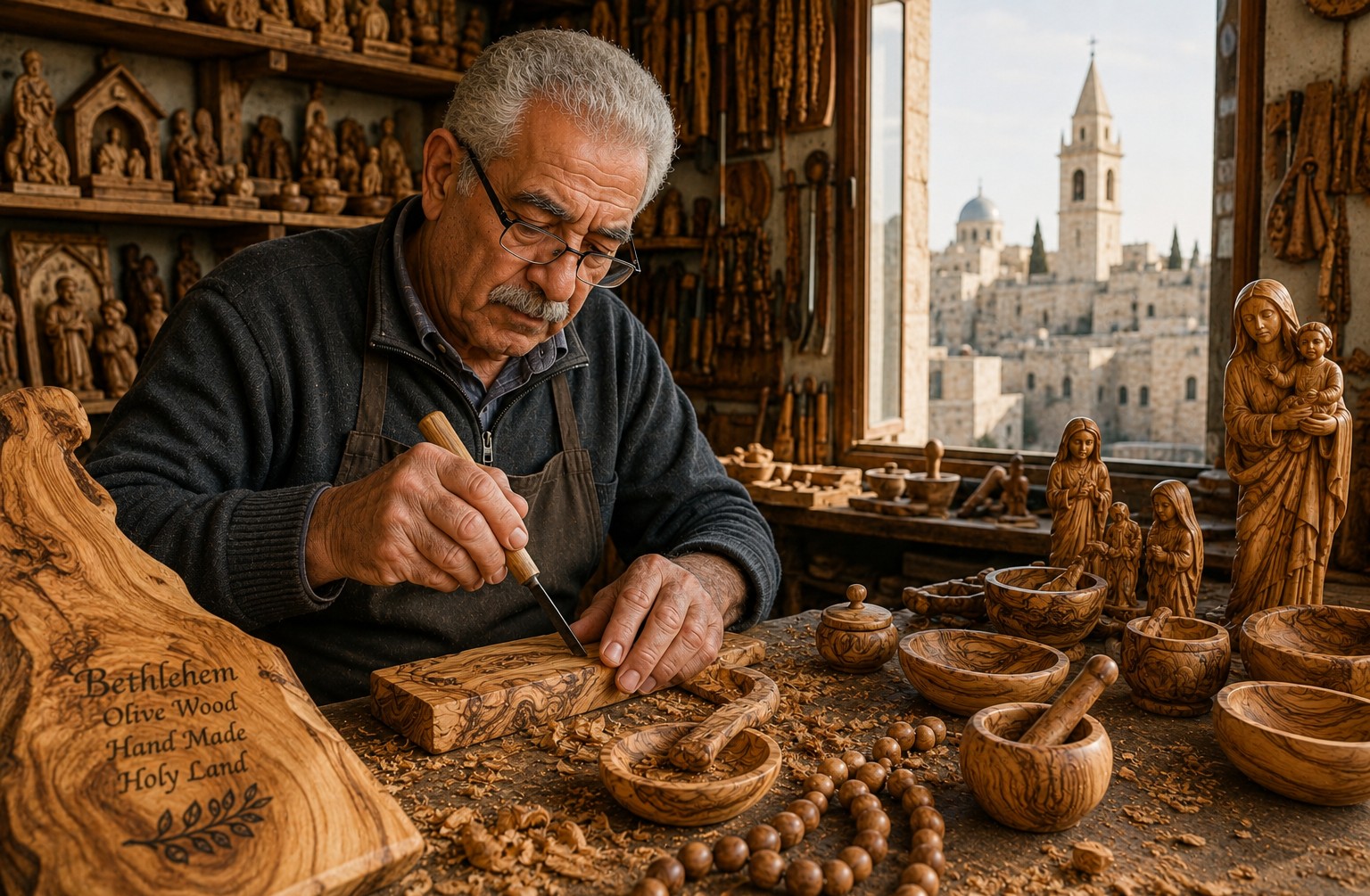
The story begins with the philosophy of "Eternity"; in Palestine, the olive tree does not die—it is reborn in the details of our homes. This is the tree that bore witness to the footsteps of prophets and the sweat of farmers. When a Palestinian artisan carves its wood, they are not merely handling a silent material; they are evoking the memory of the land. Olive wood is the ultimate embodiment of balance between the majesty of roots (Authenticity) and the beauty of the present (Modernity)—much like a Kufiya wrapped around the neck of a young woman at an international forum, announcing her identity with unbreakable elegance. In "Abu Hazem’s" workshop in Bethlehem—a sanctuary inherited through generations—there is no clock on the wall. Time here is not measured in minutes or seconds, but by the number of pieces crafted since dawn and the volume of "sawdust" covering his clothes like gold dust. In this place, time stands still to allow the hand to create without haste, for every piece earns its right to patience until it speaks the name of the earth.
The Chemistry of Patience: From Trunk to Icon
In these ancient workshops, the "labor of creation" begins as the wood dries for years under the Palestinian sun, losing its moisture but retaining its "secret." The Bethlehem artisan possesses an expert eye; he envisions the sculpture inside the raw trunk before the chisel ever touches it. The process begins with "drilling" followed by meticulous manual carving, respecting the natural grain and the gradient of colors ranging from honey-gold to burnt umber. This is where the magic lies: no two pieces of olive wood are identical—just as no two human stories are the same. Every piece emerging from the artisan’s hand is a unique "genetic footprint," carrying the specific history of its tree and the unique curves of its time.
The Geography of Carving: The Cradle of the Story and its Journey
This craft is centered in the heart of Bethlehem, Beit Sahour, and Beit Jala, historically linked to the crafting of "Rosaries" and "Icons" that pilgrims carried as blessings from the Holy Land to the far corners of the globe. Today, this heritage is integrated into our modern lives; you find olive wood shaped into contemporary home-ware, wall clocks designed to grace "modern" homes, and office accessories that remind you of your identity in every moment of work. It is the craft that traveled from the Grotto of the Nativity to become a global language of elegance, proving that the Palestinian hand is capable of turning a "branch" into a "message of resilience."
The Star of Wisdom (In the Words of Grandmother Laila)
Grandmother Laila touches the surface of an olive wood table, stroking it with her wrinkled palm as she speaks to young Reham: "My dear Reham, olive wood possesses a 'Baraka' (blessing) that soothes the soul. When you touch it, it’s as if you are greeting my grandmother and yours, who planted the tree a hundred years ago. Look, my daughter, Abu Hazem and those like him are the guardians of our homeland’s fragrance. Machines today churn out plastic and iron with no soul, but this wood breathes with you in the house. Cherish this piece, my dear; clean it with a little olive oil, and it will keep shining like your pure heart. This isn't just wood—this is a 'Shuqfa' (a piece) of our soil and the preciousness of our land."
Conclusion
Owning a piece of olive wood is a celebration of a tree whose greatness has been sworn by history; it is a tribute to the hand of "Abu Hazem," which never tires of giving. While fashions change and eras pass, the scent of the olive remains the only constant that binds us to our first groves. Olive wood is still enduring.