The Hejaz Railway
The Train of the East That Wove Longing Across Palestine’s Mountains and Plains
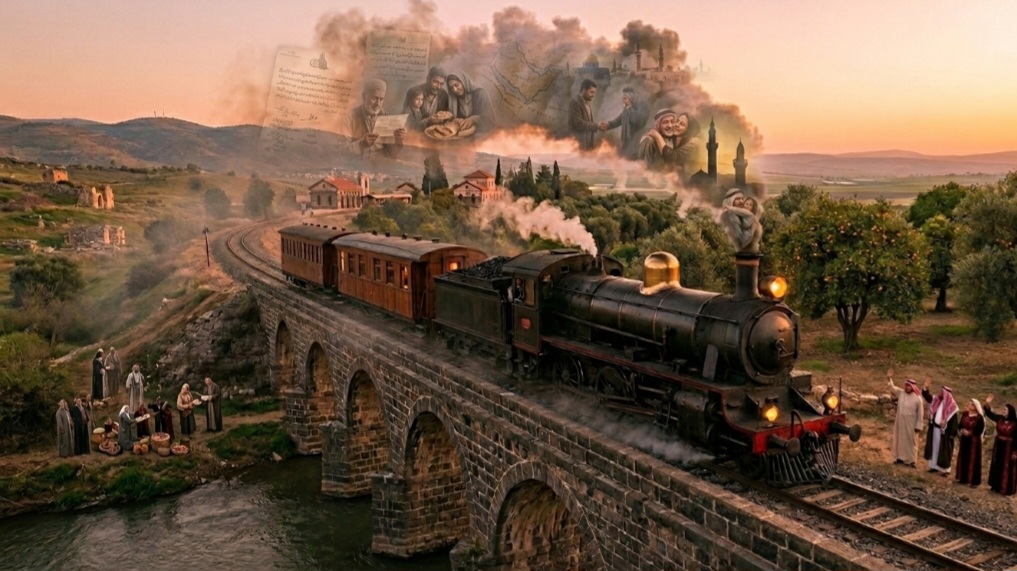
Where the Whistle Echoed Through the Valleys
The piercing whistle that shattered the silence of the valleys, and the dark smoke rising above the orange groves of Jaffa and the plains of Marj Ibn ‘Amer, announced the arrival of a new age. The Hejaz Railway was never merely a stretch of cold iron tracks laid across the land. It was a living artery that connected cities to one another and carried the pulse of an entire region — linking the minarets of Damascus with the walls of Jerusalem and the sacred horizons of Medina.
The Dream That Became Reality: The Artery of the Caliphate
In 1900, during the reign of Sultan Abdul Hamid II, construction began on one of the most ambitious projects of its era. The railway was designed to ease the pilgrimage journey to the holy cities — a journey that once took exhausting months and was fraught with danger. With the coming of the railway, the same route could be crossed in only a matter of days. Yet Palestine was never merely a passing stop along this route. It became one of the railway’s most vital lungs through its famous branch line leading toward Haifa.
The Haifa Branch: Where Mountain Met Sea
The Haifa branch of the Hejaz Railway remains one of the most historically significant sections of the network. Beginning in Daraa, the line descended through the Jordan Valley before climbing toward Beisan and continuing onward to Acre and Haifa. 1- The Architecture of the Stations: Railway stations such as Samakh, Beisan, Jenin, and Tulkarm were constructed in a distinctive architectural style that blended black basalt stone with pale limestone. To this day, these stations stand as silent witnesses to the elegance and sophistication of the era’s architecture. 2- Economic Transformation: Thanks to the railway, Haifa evolved from a modest coastal town into an international port and commercial hub, connecting the goods of Greater Syria to European markets.
The Journey of Stories: Memory, Travel, and the People
In Palestinian collective memory, the train was never simply a means of transportation; it was a social occasion in itself. People waited eagerly for the arrival of the wabour — the popular local name for the steam locomotive — carrying goods, letters, and travelers from distant cities. Songs of Farewell: Along the station platforms, farewell ballads and songs of longing were born. Lovers parted there, strangers met there, and the scent of coal smoke mixed with the clang of iron hammers became part of the living soundscape of Palestinian towns and villages.
Engineering Against the Land
Researchers today remain astonished by the engineering precision behind the railway’s construction, especially the famous Jisr al-Majami‘ bridge spanning the Jordan River. Engineers confronted rugged mountains and unforgiving desert terrain with extraordinary determination, transforming the railway into one of the early twentieth century’s greatest engineering achievements. Even more remarkable was the fact that the project was financed entirely through Ottoman and Islamic donations, without dependence on foreign debt.
Ruins That Still Speak of Unity
Although the train ceased running after the First World War and the fragmentation of the region that followed, the surviving tracks, bridges, and stations scattered across Tulkarm, Sebastia, Beisan, and Jerusalem continue to tell the story of a once-connected geography. To document this heritage today is to affirm that Palestine has always stood at the crossroads of the world — a passageway for civilization and a bridge of human connection.