Palestine Through Orientalist Lenses
When the Mystique of the “East” Met the Western Camera
Framing the Holy: The Birth of Palestine’s Global Archive
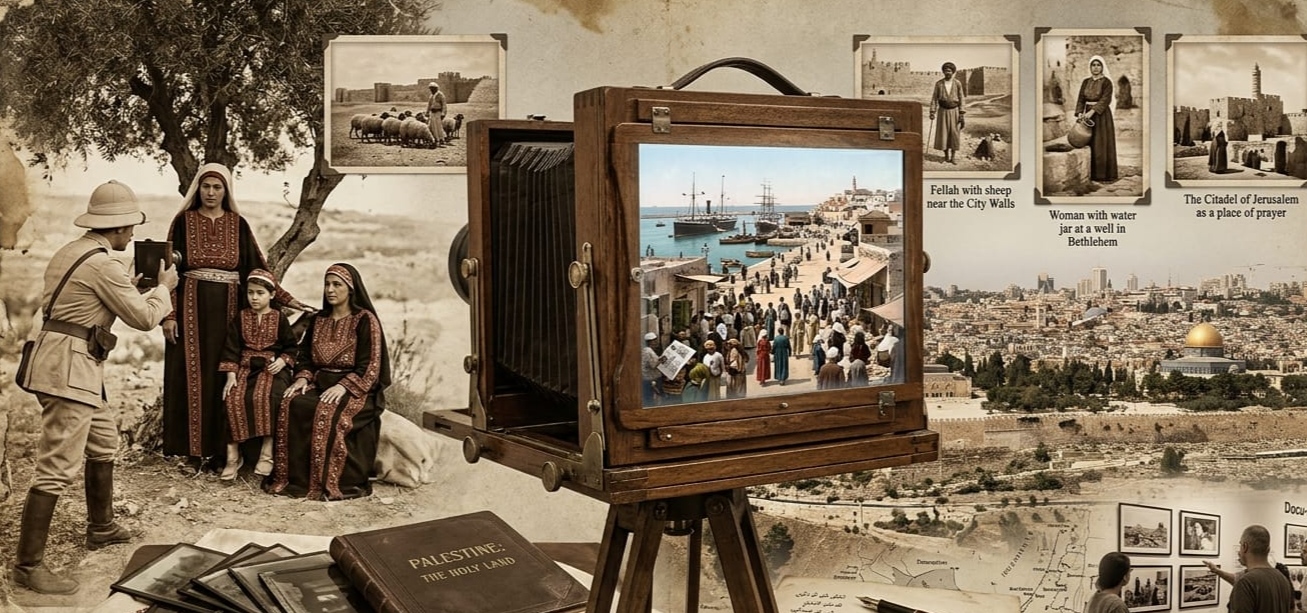
With the invention of photography in the mid-nineteenth century, Palestine was never just another destination on the itineraries of foreign photographers. To many Western lenses, it was “the Holy Land” — a place suspended between scripture, myth, and longing. Between 1839 and 1920, hundreds of photographers and Orientalist travelers arrived carrying cumbersome wooden cameras, producing thousands of images that would become the world’s first visual archive of Palestine. Yet those photographs raise an enduring question: were they documenting reality, or constructing an imagined East?
The Rush Toward the Holy Land
The Orientalist photographer was rarely searching for modern life; he was searching for “biblical time.” Photographers such as Francis Bedford and Félix Bonfils arrived with the stories of prophets already fixed in their imagination. Their lenses focused intensely on Jerusalem, Bethlehem, and Nazareth, seeking to preserve sacred geography rather than contemporary society. These photographs were created for European audiences eager to see the landscapes they knew only through scripture. In many ways, they became a form of “visual pilgrimage” for those who would never reach Palestine themselves.
The Palestinian People: Between Reality and Stereotype
Through many Orientalist lenses, Palestinians appeared within carefully staged and static frames. Photographers often selected peasants in traditional dress, shepherds with their flocks, and women gathered at village wells to reinforce the impression that life in Palestine had remained untouched for centuries. The historical irony, however, is striking. While Orientalist photography portrayed Palestine as timeless and primitive, cities such as Jaffa and Jerusalem were experiencing vibrant cultural, commercial, and journalistic growth. Much of this urban transformation was deliberately excluded from the frame, as it conflicted with the Western narrative that sought an unchanging “biblical East” rather than a living and evolving society.
The Bonfils School: Recording the Finest Details
The Bonfils family remains among the most significant photographic chroniclers of Palestine. Their work stood out for its extraordinary attention to architectural detail, particularly in their images of Al-Aqsa Mosque and the Church of the Holy Sepulchre. They also documented Palestinian traditional dress with remarkable precision. Today, these photographs allow heritage researchers to trace embroidery patterns and study how regional styles evolved across Palestinian villages and cities.
Documentary Value: A Double-Edged Archive
Although many Orientalist photographs were carefully staged and shaped by the photographer’s artistic or ideological vision, they remain an irreplaceable historical treasure for several reasons: 1- Proof of Presence: These images document Palestinian towns and villages that were destroyed in 1948, while also preserving scenes of daily life in bustling markets, ports, and public spaces. 2- Architectural Memory: They provide a visual record of Palestinian cities before the dramatic transformations brought by modern urban expansion. 3- Aesthetic and Cultural Preservation: They safeguarded the faces, crafts, and traditional details of a society whose material heritage was later threatened with disappearance.
From the Orientalist Lens to a National Reading
Today, when these photographs are revisited in archival and cultural platforms, they are no longer viewed solely through the romantic gaze of the West. We look at them differently. We do not see merely an “exotic East”; we see our grandparents, our cities, our fields, and the enduring evidence of a people rooted in their land. The very camera that once arrived searching for an ancient and frozen past has, over time, become an unintended witness to a living and continuous Palestinian presence.